
Gracie Abrams Mews Meaning and Review
A Quiet Kind of Heartbreak
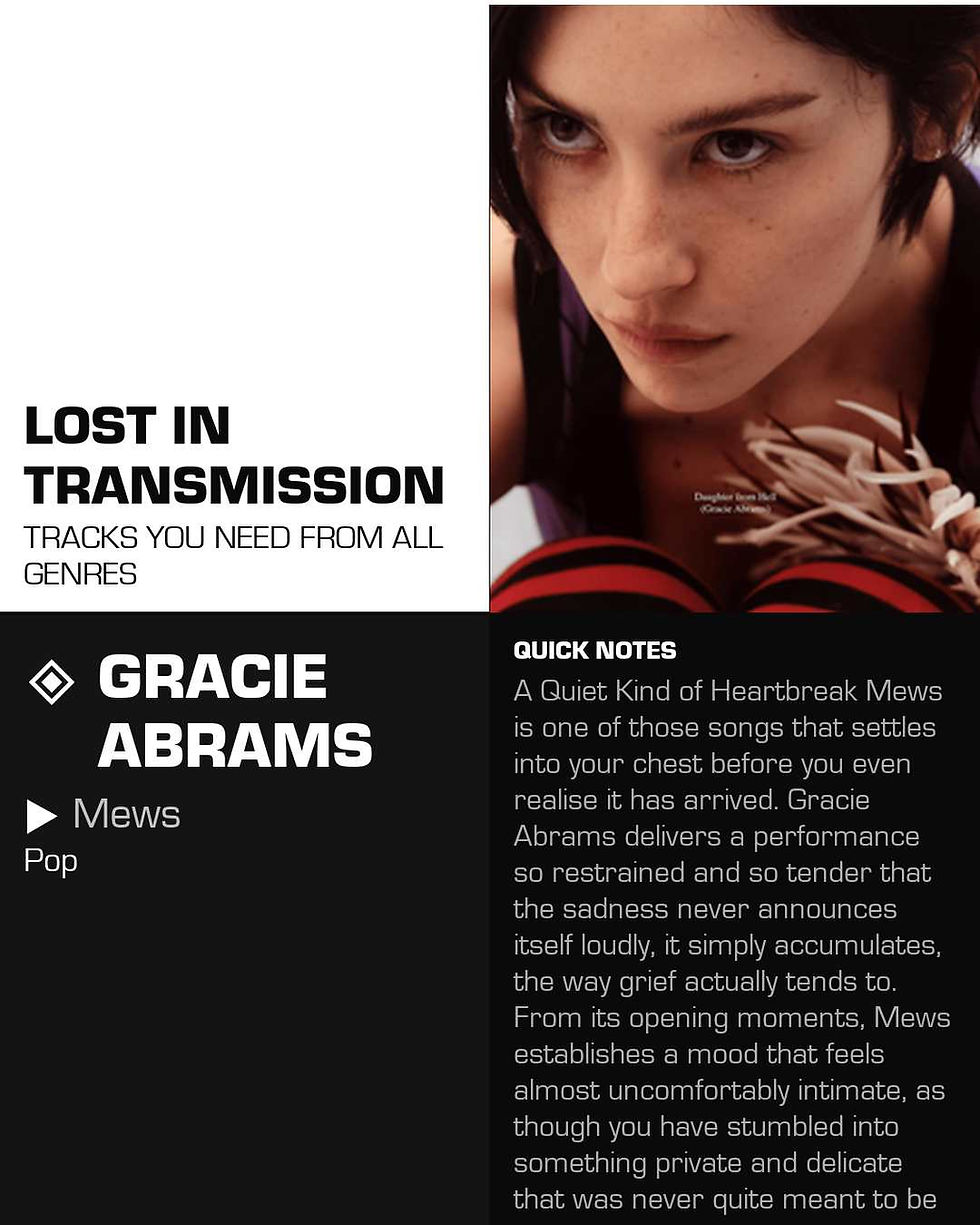
Mews is one of those songs that settles into your chest before you even realise it has arrived. Gracie Abrams delivers a performance so restrained and so tender that the sadness never announces itself loudly, it simply accumulates, the way grief actually tends to. From its opening moments, Mews establishes a mood that feels almost uncomfortably intimate, as though you have stumbled into something private and delicate that was never quite meant to be witnessed by anyone else.
Production That Breathes
The collaboration between Gracie Abrams and Aaron Dessner yields exactly the kind of sonic environment that suits Mews so naturally. Dessner brings his characteristic gift for space and texture, constructing a landscape around the vocal that feels sparse without ever feeling cold. Every element in the production of Mews seems to have been chosen for what it withholds as much as for what it offers, and the result is a song that feels like it is barely holding itself together, which is precisely the point.
Gracie at Her Most Vulnerable
Vocally, Gracie Abrams gives Mews a fragility that is deeply affecting. There is no overreach, no moment where the emotion is pushed beyond what feels truthful, and that restraint is what makes Mews land as hard as it does. Her voice sits low in the mix in a way that feels intentional, pulling the listener closer rather than projecting outward, creating a closeness that is central to how Mews communicates its sadness.
Tone Above All Else
The overall tone of Mews is one of quiet devastation, the kind that does not shout but instead lingers. It does not rush to resolve or comfort, and Abrams and Dessner resist any impulse to inflate the moment beyond its natural weight. Mews earns its emotional impact through patience and precision rather than dramatic flourish, and that choice feels brave given how easily a song this soft could be overlooked.
A Standout Moment on Daughter From Hell
Within the context of Daughter From Hell, Mews occupies an important emotional register. It is the kind of song that stops you mid-listen and asks you to sit with it for a moment longer than feels comfortable. Mews is a testament to what Gracie Abrams does best, finding the profound inside the quiet, and alongside Aaron Dessner, she has created something genuinely affecting that rewards every careful listen.
Listen To Gracie Abrams Mews
Gracie Abrams Mews Lyrics Meaning Explained
The meaning of Mews by Gracie Abrams is a raw, retrospective accounting of a relationship that the speaker fought for long past the point of reason, only to be left behind by someone who had already decided to leave. The song moves through grief, denial, self-reproach, and finally a painful clarity, structured around the extended metaphor of a car ride that has run its course.
The Driving Metaphor as Emotional Architecture
The song's central metaphor is relentless and precise. The relationship is a car, and it is already breaking down when the song begins: "Do you hear the sound / Of our engine fading? / Really ran it out / Four tires flaming." The speaker knows something is wrong but immediately tries to suppress it, asking "can't we just hose 'em down?" This impulse to smother the warning signs rather than address them defines the entire emotional arc. The speaker then doubles down, wanting to "drive 'til the mornin' / 'Til you forget that you're having doubts" and willing to "run every light, every warning." As the provided notes point out, this echoes her earlier line "And I blew through the traffic light" from "405," suggesting this is a recurring gesture in her work: speed and recklessness as a way of outrunning feeling rather than facing it.
By the final verse, the metaphor closes on itself with devastating neatness: "Guess I slowed you down / When you planned on racing, buckle up, kick me out." What she framed as devotion, keeping pace and staying in the car, he experienced as dead weight. The vehicle they were both supposedly riding in was already his alone.
Misread Signals and the Weight of Hindsight
The bridge is where the song becomes most forensic. The speaker picks through the wreckage of ordinary moments, trying to locate the moment she should have understood: "Did I miss the sign when you'd answer my call? / Like if between the lines, did one breath say it all?" The notes draw a compelling connection to her earlier lyric "Hey, what if I took your call as more than just a call?" suggesting she has been asking this question across albums, worrying that she over-interpreted small gestures as proof of love. Here the anxiety flips: maybe she under-read them, missing what was already spoken in what he left unsaid.
The line "When you called me naive, did you mean to a fault?" is particularly sharp. He gave her the word, handed her the diagnosis, and she still didn't use it to protect herself. There is something almost cruel in that detail, the way a person can be warned about themselves and still not be able to act on it.
Belief, Betrayal, and the Glorified Tome
"I believed every word that you read / Every glorified tome by the side of your bed" is a quietly devastating image. She didn't just believe him, she believed his whole self-presentation, the books he kept, the intellectualism or idealism they implied. "When you swore you'd go right / Then you went left instead" uses the simplest possible language to describe a fundamental betrayal of character. The person she believed in, the person those books suggested he was, did not exist in the way she needed him to.
The Cost of Loyalty
The final chorus lands the song's most gut-punch moment: "I would've fought anybody / Who tried to tell me you wanted out / Beat to a pulp, 'til I'm bloody / Oh God, you can bet, I regret it now." The violence of the image is important. She didn't just love him passively; she was his defender, his advocate, willing to go to war on his behalf. The regret isn't just about losing him, it's about the ferocity she wasted. She would have destroyed anyone who told her the truth, and now that truth is the only thing left.
What "Mews" Holds Together
Taken as a whole, the song is about the particular grief of someone who gave everything to a relationship that the other person had privately already abandoned. The speaker was not passive or oblivious, she was actively, aggressively committed, and that commitment is exactly what she now has to mourn. Gracie Abrams builds the song carefully so that each metaphor feeds back into the same wound: the car that was already dying, the calls she misread as signs, the books she believed, the fights she would have picked. All of it points to a love that was total on one side and already over on the other, and the ache of not knowing which one you were until the very end.
Gracie Abrams Mews Lyrics
Verse 1
Do you hear the sound
Of our engine fading?
Really ran it out
Four tires flaming, can't we just hose 'em down?
Chorus
'Cause I wanna drive 'til the mornin'
'Til you forget that you're having doubts
Run every light, every warning
Still, if you want, we can have it out
Out, out
Once was a rock, I'm your hard place now
Now, now
You floor it, I choke when you find the ground
Verse 2
Tell me where you've landed
Don't you thank me now
For my understanding
There's none of that, close your mouth
Chorus
I wanna scream 'til I'm burnin' up
I want your family to know me now
I'm not, but I seemed more important, love
To you before it all changed somehow
Somehow, how
I moved with your tide 'til it turned around
Around, 'round
Still, you should know, oh
Bridge
I believed every word that you read
Every glorified tome by the side of your bed
When you swore you'd go right
Then you went left instead
How was I supposed to know? Oh
Did I miss the sign when you'd answer my call?
Like if between the lines, did one breath say it all?
When you called me naive, did you mean to a fault?
Oh, no, mm-mm
Verse 3
But it's over now
You're not outside waiting
Guess I slowed you down
When you planned on racing, buckle up, kick me out (Out)
Chorus
I would've fought anybody
Who tried to tell me you wanted out
Beat to a pulp, 'til I'm bloody
Oh God, you can bet, I regret it now
And now, now
Oh, you can bet I regret it now
And now, now


Comments