
Halsey Charades Meaning and Review
A Haunting Surrender: Halsey's "Charades"
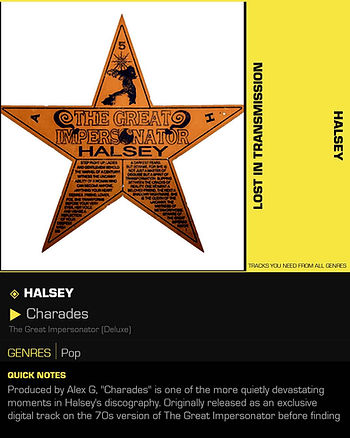
Produced by Alex G, "Charades" is one of the more quietly devastating moments in Halsey's discography. Originally released as an exclusive digital track on the 70s version of The Great Impersonator before finding a wider audience on the deluxe edition, Charades carries the weight of something deeply personal and unresolved. From the first note, there is a feeling of fragility here that Halsey leans into rather than away from, and the result is a piece of music that lingers long after it ends.
Tone and Atmosphere
The emotional atmosphere of Charades is one of exhausted surrender. There is nothing performative about the way the song feels. It does not reach for drama or spectacle. Instead, Charades settles into a kind of quiet devastation, the kind that comes not from explosive emotion but from someone who has already moved through the worst of it and is now simply speaking plainly. The tone is intimate and worn, like a letter written at three in the morning with no expectation of a reply.
Production and Sound
Alex G's production on Charades is restrained in the best possible way. The sonic landscape he builds feels unhurried and deliberately sparse, giving Halsey's voice room to exist without competition. There is a warmth to the production that feels almost weathered, as though the music itself has been through something. The choices made here serve the emotional core of Charades without ever overshadowing it, which speaks to a thoughtful and sensitive collaborative dynamic between artist and producer.
Halsey's Vocal Performance
Halsey's voice on Charades is among her most unguarded work. She is not singing to impress here. She is singing to release. There is a rawness to the delivery that feels earned rather than manufactured, a vulnerability that comes across not through technical display but through restraint and honesty. The way she inhabits Charades vocally makes it clear that the distance between the artist and the song is very small indeed.
Final Thoughts
Charades is the kind of song that earns its place on an album not by being the loudest or the most immediately striking, but by being utterly sincere. Its journey from exclusive digital release to the wider deluxe edition feels fitting, because Charades is a song that deserves to be heard. It is quiet, it is heavy, and it is real. In a body of work as layered and ambitious as The Great Impersonator, Charades stands out precisely because it asks for so little while giving so much.
Listen To Halsey Charades
Halsey Charades Lyrics Meaning Explained
The meaning of Charades by Halsey is a raw, unflinching portrait of someone performing wellness and normalcy while quietly disintegrating from within a person so accustomed to silence and survival that they can only hope the world is perceptive enough to read what they cannot say aloud.
The Performance as Central Metaphor
The song's controlling metaphor is established before a single lyric is sung. The intro frames everything that follows as a spectacle: "The most death-defying leap ever attempted / Watch her closely." Given the context that Halsey created this album while genuinely facing the possibility of death from illness, this framing is not theatrical posturing it is a literal truth dressed in the language of a carnival act. The entire song becomes a stage, and the central question it keeps asking is whether anyone in the audience is paying close enough attention to understand what they're actually witnessing.
Charades, as a game, depends on communicating without words. The title tells you everything: Halsey is not hiding, exactly she is performing her pain as loudly as she can in a language most people aren't fluent in.
Silence as Self-Protection
A through-line in the song is the way silence and smallness were learned as survival strategies. "Pretendin' that I'm small / 'Cause I'd be in trouble if I grew" and "Pretendin' I was fine / 'Cause I'd be in trouble if they knew" reveal a person who was conditioned early by poverty, by instability, by a father who "won't be coming around" to take up as little space as possible. Being born a "welfare baby / with the blisters in my shoes" meant that need itself was dangerous, that wanting or growing or speaking could invite consequences.
This learned smallness calcified into something more damaging over time. The chorus lands on it plainly: "I've been confusing afraid and well-behaved." This is one of the song's most quietly devastating lines. Years of suppressing need in the name of safety has made compliance feel like virtue. Halsey has been mistaking fear for good character, suffering for bravery.
The Body in Crisis
The second verse shifts into the physical dimension of this crisis. "Three words and four syllables / Doctor told me I'm not invincible" is a syllabic mirror of a cancer diagnosis "You have cancer" delivered with the same clinical brevity a doctor might use. The line doesn't dramatize; it simply counts. It is followed immediately by the admission that she had been "livin' like I was for far too long," suggesting that the body's fragility had been ignored in the same way her emotional needs were: pushed down, performed around, and refused acknowledgment.
The image of bleeding on stage reaches its most literal meaning here. The note about Halsey having a miscarriage at twenty and still performing because of the stakes attached to the show brings crushing weight to the line "Can you see that I'm bleeding on the stage?" The stage has always demanded she keep going. The body has always been something to push through rather than listen to.
Faith, Abandonment, and the Collapse of Prayer
The song returns repeatedly to the image of unanswered prayer: "I don't waste my time at all, nobody answers when I pray." The pastor who "kicked me out because of tithes that went unpaid" is a specific, bitter memory an institution that promised unconditional grace and then withdrew it over money. It is a perfect encapsulation of the song's broader theme: every system or person Halsey reached toward for help (family, faith, medicine, God) has either left, stayed silent, or turned transactional.
By the chorus, the silence has become total. "I don't talk to God, I don't talk at all / I'm quiet most these days." This is not peaceful quiet. It is the quiet of someone who has asked enough times to know no answer is coming.
The Outro and Its Ambivalence
The outro softens into something almost playful on the surface "Maybe you and I, we should play / Should we give it a go" but the tenderness is undercut by exhaustion. "I don't wanna give it away" suggests that even now, even in a song explicitly about wanting to be understood, the old reflex toward concealment hasn't fully released. The final line, "I know you could get it if you paid attention," is the whole song's thesis distilled: the pain is visible. It has always been visible. The question is only whether anyone is willing to look.
What the Song Ultimately Says
Charades is a song about the brutal cost of a lifetime of emotional suppression the way poverty and abandonment teach a person that their needs are a liability, and how that lesson doesn't just shape behavior but rewires what a person believes they deserve. It is also, by virtue of its very existence, a refusal of that lesson. Finishing and releasing an album while facing death is, as the intro frames it, a death-defying leap. The song doesn't resolve into hope, but it does insist on being heard which, for someone who spent so long pretending to be small, is its own form of survival.
Halsey Charades Lyrics
Intro
Ladies and gentlemen
You are about to witness
The most death-defying leap ever attempted
Watch her closely
Verse 1
The words, they don't come easy
But the feelings come all strong
I know words should make me happy
If sometimes I play along
My chest on set fire, there's no burnin' in my lungs
Just an empty space I've labeled as
"The things that I should love"
Pre-Chorus
All that cuts through
Is the fear of what I'll lose
I was born a welfare baby
With the blisters in my shoes
Pretendin' that I'm small
'Cause I'd be in trouble if I grew
Pretendin' I was fine
'Cause I'd be in trouble if they knew (Trouble if they knew)
Chorus
I've been confusing afraid and well-behaved
Been sacrificin' things that I want because I thought
That it would make me brave
And since the pastor kicked me out because of tithes that went unpaid
I don't waste my time at all, nobody answers when I pray
Are you good at charades? (Oh, oh)
Can you see that I'm bleeding on the stage?
Can you feel the things I'm screamin' even when I cannot say?
I don't talk to God, I don't talk at all
I'm quiet most these days
So are you good at charades?
Verse 2
Three words and four syllables
Doctor told me I'm not invincible
But I've been livin' like I was for far too long
A big world feelin' real small now
Every day, I'm dizzy in the roundabout
Daddy told me that he won't be coming around
Pre-Chorus
The only way that I'll get through
Is to tell them that I refuse
'Cause I was born a welfare baby
So I got nothing left to lose
And I'm pretendin' it don't hurt
'Cause I know somehow I'll make do
I know exactly how to be alone
Because it's all I ever knew
Chorus
I'm afraid to feel like a burden, so I lie awake
Try not to get too attached 'cause I know that they'll leave anyway
Ever since that pastor kicked me out because of tithes that went unpaid
I don't waste my time at all, nobody answers when I pray
Are you good at charades? (Oh, oh)
Can you see that I'm bleeding on the stage?
Can you feel the things I'm screamin' even when I cannot say?
I don't talk to God, I don't talk at all
I'm quiet most these days
So, are you good at charades? Are you any good at charades?
Outro
Maybe you and I, we should play
Should we give it a go, 'cause nobody knows?
At the end of the day, it's just a harmless game
Well, I don't wanna give it away
And I know you could get it if you paid attention
Are you good at charades?
Are you any good at charades? Mm


Comments