
Noah Kahan The Great Divide Meaning and Review
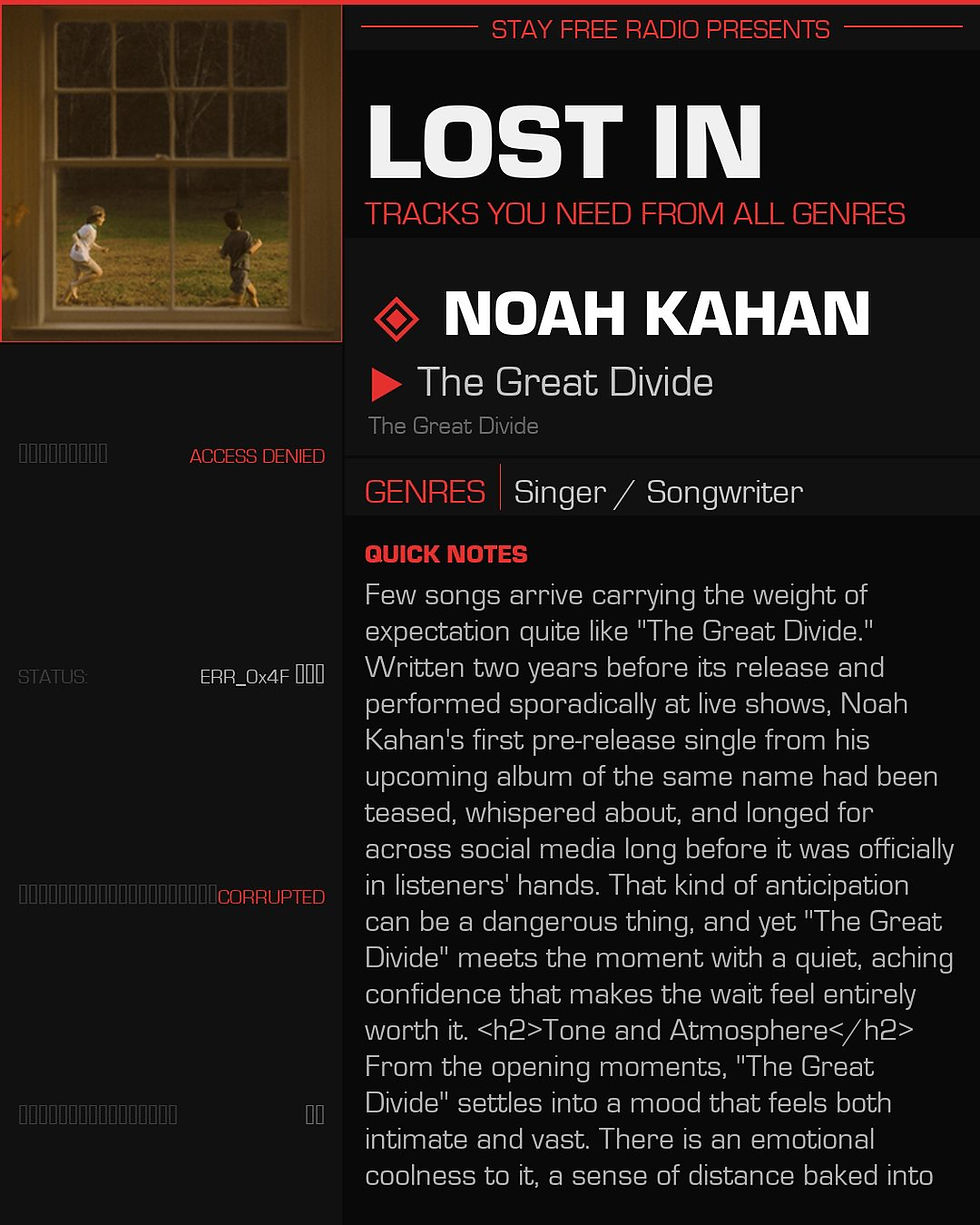
A Long-Awaited Arrival
Few songs arrive carrying the weight of expectation quite like "The Great Divide." Written two years before its release and performed sporadically at live shows, Noah Kahan's first pre-release single from his upcoming album of the same name had been teased, whispered about, and longed for across social media long before it was officially in listeners' hands. That kind of anticipation can be a dangerous thing, and yet "The Great Divide" meets the moment with a quiet, aching confidence that makes the wait feel entirely worth it.
Tone and Atmosphere
From the opening moments, "The Great Divide" settles into a mood that feels both intimate and vast. There is an emotional coolness to it, a sense of distance baked into the very texture of the sound. It does not announce itself loudly. Instead, it creeps in, carrying undertones of religious trauma and the particular grief of a relationship slowly coming undone. The atmosphere Kahan conjures here is one of restraint, of things unsaid, of rooms where two people are present but no longer truly together.
Sound and Production
Produced by Gabe Simon and Noah Kahan, "The Great Divide" is a masterclass in measured production. Nothing here is overworked or excessive. The sonic landscape breathes, leaving space for tension to settle and linger in a way that mirrors the emotional core of the song itself. Simon and Kahan resist the urge to swell where other productions might reach for catharsis, and that restraint is precisely what gives "The Great Divide" its power. The production feels like the musical embodiment of suppression, a controlled ache that never quite releases.
Kahan's Performance
Vocally and emotionally, Kahan delivers "The Great Divide" with a weariness that feels entirely earned. There is no performance for the sake of it here. His voice carries the particular exhaustion of someone who has been reaching across a growing distance for too long, and it translates with an authenticity that has become something of a signature in his work. Reflecting on the song, Kahan shared that it emerged from thinking about the divides in his own life, whether with older versions of himself or the people he grew up with and continues trying to hold onto. That honesty is felt throughout.
Conclusion
"The Great Divide" is a striking opening statement for the album ahead. It is patient, considered, and emotionally precise in a way that rewards careful listening. As a pre-release single, it sets a tone that is both familiar to longtime fans and quietly ambitious in its execution. If "The Great Divide" is any indication of what the album holds, Kahan is stepping into this next chapter with real intention and an assured artistic voice.
Listen To Noah Kahan The Great Divide
Noah Kahan The Great Divide Lyrics Meaning Explained
The meaning of The Great Divide by Noah Kahan is a meditation on fractured connection, survivor's guilt, and the kind of love that only becomes legible in hindsight. It is a song about looking back at someone you failed to truly see and reckoning with what that blindness cost them both.
A Bond Built on Scar Tissue
The song opens by dismantling any romantic notion of what the relationship was. Kahan is unflinching in his assessment: "We got cigarette burns in the same side of our hands, we ain't friends / We're just morons, who broke skin in the same spot." Rather than leaning into the idea that shared pain creates soulmates, Kahan collapses that mythology entirely. The word "morons" is doing crucial work here. It refuses the "tortured artist" framing and replaces it with something more honest and more painful: two people making bad decisions in parallel, connected not by genuine intimacy but by coincidental damage. The burns are not a symbol of solidarity. They are evidence of a relationship that existed primarily because both people happened to be at their lowest at the same time.
This sets the emotional foundation for everything that follows. The "Great Divide" of the title is not just geographic, though the song does reference the Twin State line as a literal boundary. It is the distance between who these two people were to each other on the surface and what was actually happening underneath, the gap between proximity and understanding.
The Weight of What Was Left Unsaid
Kahan describes attempting to reach across that divide in real time, only to be shut out: "So I tried to read the thoughts that you'd worked overtime to stop / You said, 'Fuck off,' and I said nothin' for a while." The phrase "worked overtime to stop" is particularly striking. The other person has not merely kept their feelings private. They have been actively, exhaustingly suppressing them. And when Kahan reaches toward that hidden interior, the response is a wall. His silence in return is not indifference. It reads more like a retreat, a moment where vulnerability is met with hostility and he simply does not know what to do.
This dynamic is deepened in the pre-chorus, where Kahan reflects on the belated clarity that time has brought him: "You know I think about you all the time / And my deep misunderstanding of your life / And how bad it must have been for you back then / And how hard it was to keep it all inside." The admission of a "deep misunderstanding" is where the guilt lives. He is not claiming he was cruel or absent in any dramatic sense. He is saying something quieter and perhaps harder to sit with: that he was simply unaware, and that this unawareness had a real cost for someone who was struggling in his peripheral vision.
Ordinary Fear as a Form of Hope
The chorus is where the song reveals the depth of Kahan's longing for this person's wellbeing, filtered through an imagination that can only hope because it no longer knows: "I hope you settle down, I hope you marry rich / I hope you're scared of only ordinary shit / Like murderers and ghosts and cancer on your skin / And not your soul and what He might do with it."
The structure of this chorus is quietly devastating. Kahan is not wishing the friend happiness in vague terms. He is wishing them access to ordinary human fear, the kind that comes from external threats rather than internal ones. The contrast between "cancer on your skin" and "your soul and what He might do with it" is the emotional hinge of the entire song. Physical danger is terrifying, but it is comprehensible and external. The fear of one's own soul, of divine judgment or spiritual worthlessness, is the kind of dread that comes from somewhere much darker and much harder to treat. Kahan is implying that whatever this person was carrying was rooted in precisely that kind of self-condemnation.
By wishing them ordinary fear, he is wishing them peace from the extraordinary kind.
The Divide as a Literal and Emotional Crossing
The second verse introduces one of the song's most arresting images: "You inched yourself across the great divide / While we drove aimlessly along the Twin State line." The word "inched" carries enormous weight. It suggests slowness, effort, and a kind of quiet determination that nobody around them recognized or acknowledged. While Kahan and others were simply drifting, this person was moving toward something, or away from something, in a way that went unnoticed.
The lines that follow gesture toward the particular loneliness of being someone whose inner life is inaccessible to the people around them: "I heard nothing but the bass in every ballad that you'd play / While you swore to God the singer read your mind." Kahan was hearing surface sound while the other person was finding their entire emotional reality reflected back at them through music. They were speaking different languages in the same car.
He then turns the critique on himself: "And I'm finally aware of how shitty and unfair / It was to stare ahead like everything was fine." There is no deflection here. He is not blaming circumstance or youth. He is naming his own failure of attention plainly and without excuse.
Rage, Restraint, and the Courage He Lacked
The bridge distills the song's central tension into its most concentrated form: "Rage, in small ways / Did you wish that I could know / That you'd fade to some place / I wasn't brave enough to go?" The "small ways" is important. This was not a person given to dramatic expressions of feeling. Their rage was contained, parceled out in quiet increments, which made it even easier to miss. And Kahan's question to them is also a question about himself: did they know that wherever they were going, emotionally or otherwise, he lacked the courage to follow? That the divide was not just about their unwillingness to let him in, but also about his own limits?
Letting Go as an Act of Love
The outro shifts the tone slightly. Where the chorus has been wistful and prayerful, the outro gains a kind of fierce tenderness: "I hope you threw a brick right into that stained glass / I hope you're with someone who isn't scared to ask / I hope that you're not losing sleep about what's next / Or about your soul and what He might do with it."
The stained glass image suggests institutional religion, or perhaps the more general weight of inherited guilt and judgment. Hoping they threw a brick through it is Kahan wishing them liberation from whatever spiritual framework had become a source of shame rather than comfort. And "someone who isn't scared to ask" is, implicitly, the person Kahan admits he was not. He could not bring himself to ask. He stared ahead and said nothing for a while. His hope for them now includes the hope that they have found someone capable of the very courage he lacked.
The song ends where it began, circling back to the soul and what He might do with it, but the repetition now feels less like an unanswered question and more like a prayer finally spoken aloud. Kahan cannot fix the past, cannot recover the conversation that never happened. What he can do is refuse to look away from it, and in doing so, offer a kind of witness, however late, to someone who deserved to be seen.
Noah Kahan The Great Divide Lyrics
Verse 1: Noah Kahan
I can't recall the last time that we talked
About anything but looking out for cops
We got cigarette burns in the same side of our hands, we ain't friends
We're just morons, who broke skin in the same spot
But I've never seen you take a turn that wide
And I'm high enough to still care if I die
So I tried to read the thoughts that you'd worked overtime to stop
You said, "Fuck off," and I said nothin' for a while
Pre-Chorus: Noah Kahan
You know I think about you all the time
And my deep misunderstanding of your life
And how bad it must have been for you back then
And how hard it was to keep it all inside
Chorus: Noah Kahan
I hope you settle down, I hope you marry rich
I hope you're scared of only ordinary shit
Like murderers and ghosts and cancer on your skin
And not your soul and what He might do with it
Verse 2: Noah Kahan
You inched yourself across the great divide
While we drove aimlessly along the Twin State line
I heard nothing but the bass in every ballad that you'd play
While you swore to God the singer read your mind
But the world is scared of hesitating things
Yeah, they only shoot the birds who cannot sing
And I'm finally aware of how shitty and unfair
It was to stare ahead like everything was fine
Pre-Chorus: Noah Kahan
You know I think about you all the time
And my deep misunderstanding of your life
And how bad it must have been for you back then
And how hard it was to keep it all inside
Chorus: Noah Kahan & Dylan Jones
I hope you settle down, I hope you marry rich (Oh-oh)
I hope you're scared of only ordinary shit (Oh-oh)
Like murderers and ghosts and cancer on your skin (Oh-oh)
And not your soul and what He might do with it
Post-Chorus: Noah Kahan
Ah, Lord
Bridge: Noah Kahan
Rage, in small ways
Did you wish that I could know
That you'd fade to some place
I wasn't brave enough to go?
Chorus: Noah Kahan
I hope you settle down, I hope you marry rich
I hope you're scared of only ordinary shit
Like murderers and ghosts and cancer on your skin
And not your soul and what He might do with it
Post-Chorus: Noah Kahan & Dylan Jones
Ah (Ah), woah
Ah
Ah, Lord
Ah
Outro: Noah Kahan
I hope you threw a brick right into that stained glass
I hope you're with someone who isn't scared to ask
I hope that you're not losing sleep about what's next
Or about your soul and what He might do with it


Comments