
Phoebe Bridgers Still Standing Meaning and Review
A Haunting Return
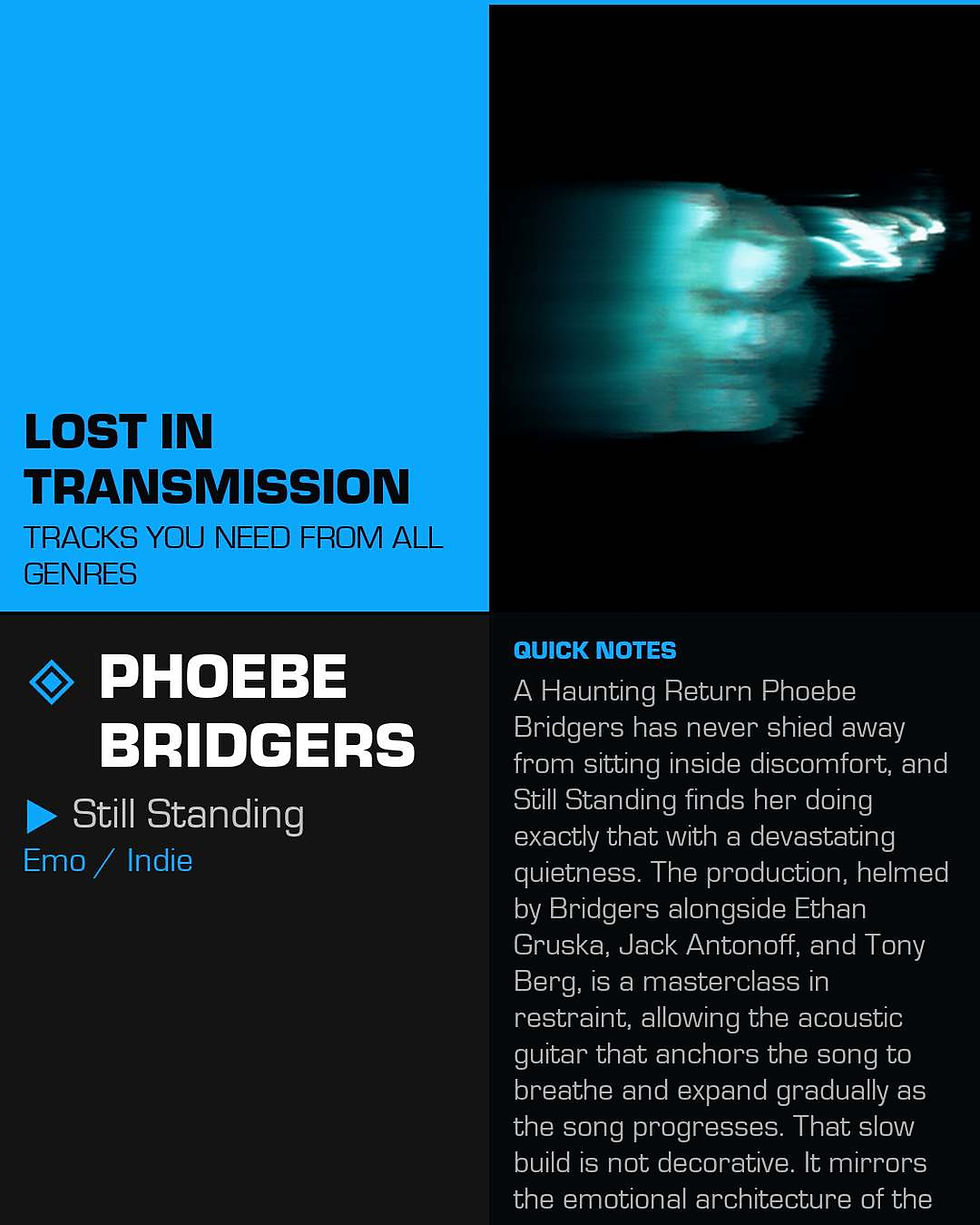
Phoebe Bridgers has never shied away from sitting inside discomfort, and Still Standing finds her doing exactly that with a devastating quietness. The production, helmed by Bridgers alongside Ethan Gruska, Jack Antonoff, and Tony Berg, is a masterclass in restraint, allowing the acoustic guitar that anchors the song to breathe and expand gradually as the song progresses. That slow build is not decorative. It mirrors the emotional architecture of the piece itself, starting at a place of stillness and accumulating weight as each verse unfolds.
Sound and Production
The acoustic guitar at the heart of Still Standing does what Phoebe Bridgers has always done best: it strips everything back to something raw and skeletal before revealing how much complexity was hiding underneath all along. The production team has crafted a soundscape that feels deeply personal without ever tipping into indulgence. Gruska and Antonoff, both known for their sensitivity to vocal dynamics and space, bring a gossamer quality to the arrangement that keeps Still Standing feeling intimate even as its emotional scope widens.
Tone and Atmosphere
There is a specific kind of grief that does not announce itself loudly, and Still Standing captures it with remarkable precision. The tone is neither sentimental nor cold. It holds something in between, a kind of suspended, complicated feeling that resists easy categorisation. The guitar swells as the verses accumulate, and that gradual crescendo creates a sense of something being processed in real time rather than recalled from a safe emotional distance.
A Statement of Reclamation
What makes Still Standing stand out within the broader context of Phoebe Bridgers's work is the way its sound functions as an act of ownership. After a period away from public life shaped by painful and intrusive circumstances, this song arrives not as a confession or a plea but as something more grounded and self-possessed. The production choices reinforce this. Nothing about Still Standing sounds like it is performing for an audience. It sounds like it was made on Phoebe Bridgers's own terms, with exactly as much openness as she chose to offer.
Conclusion
Still Standing is a quietly assured piece of work from one of the most emotionally precise songwriters of her generation. The collaboration between Bridgers, Gruska, Antonoff, and Berg yields something that feels unhurried and intentional, a song that earns its emotional weight through understatement rather than drama. As an opening statement or a centrepiece of Lost Weekend, Still Standing signals exactly where Phoebe Bridgers is: present, deliberate, and on no one's terms but her own.
Listen To Phoebe Bridgers Still Standing
Phoebe Bridgers Still Standing Lyrics Meaning Explained
The meaning of Still Standing by Phoebe Bridgers is a reckoning with a childhood shaped by domestic abuse, a father's cruelty and eventual death, and the impossibility of feeling any single, clean emotion about either.
Childhood as Vulnerability
The song opens with birth itself as an act of exposure: "Pushed head first into the world / Just to be thrown in the street when you're dressed like a girl." The notes connect this to Phoebe's collaboration with Taylor Swift, where girls are told to "go out and have your fun" only to be punished for doing exactly that. The song frames femininity as a kind of original wound you arrive in the world, and the world immediately begins making you pay for what you are.
The image of being "accident prone" deepens this sense of a childhood spent in harm's way, and the detail of the suitcase left by the bed "Like you needed to know you could go whenever you wanted" suggests a household defined by instability and the constant, low-grade threat of abandonment.
The Prom Dress and the Stairs
One of the song's most striking images comes in the second verse: "Still standing at the top of the stairs, turning red / Pound for pound in a prom dress / You try to make me afraid." The prom dress echoes the first verse's "dressed like a girl," but now femininity and violence are explicitly fused. A prom dress is one of the totemic objects of idealized girlhood, and here it becomes the costume worn during a confrontation with an abusive father. The notes suggest the spatial positioning Phoebe at the top of the stairs, her father presumably below carries its own quiet charge, particularly given the line from "Letter to an Old Poet" about someone falling down stairs.
The phrase "turning red" works on two levels: the idiom for rage, and a visual contrast with "wearing black" later in the verse. Black is the color of mourning, but Phoebe says she is "feeling indifferent" while wearing it. She is dressed for grief but does not feel it, or does not feel it simply.
The Sink
The bridge is the song's most visceral moment: "I found her bleeding over the sink / But when you said sorry / You were looking at me." The notes offer two possibilities for the bleeding physical violence against Phoebe's mother, or self-harm born of the psychological toll of the relationship. What the image makes clear either way is that her mother is bleeding over the sink rather than elsewhere, trying to contain the damage, unwilling to let her suffering take up space.
The father's apology is directed not at the person who was hurt but at Phoebe, the witness. This is a precise and damning observation: he acknowledges that something wrong has occurred, but only insofar as Phoebe had to see it. The original harm goes unaddressed. "I can't remember what I said / But I didn't mean it" reads as a child's dissociation under pressure whatever absolution she offered in that moment, she now wants to take back.
Too Young to Understand, or Not
The third verse contains one of the song's most honest admissions: "I wasn't too young to understand / I just didn't think it was so bad / And it wasn't, in a way." This is not denial it is the complicated truth that children who grow up in abusive households often normalize what they experience, not because they are oblivious but because the abuse is their baseline. Understanding and minimizing are not the same thing, but they can coexist.
Grief Without Resolution
The song ends in a place that refuses comfort: "Your back to the ocean, burning red / I can't imagine you dead / But you are every day / Thank you for everything." The notes connect the ocean to "Haunted," and here it becomes a setting for an ending a sunset, something closing. The line "I can't imagine you dead / But you are every day" is quietly devastating: she cannot picture his absence, and yet his absence is the constant fact of her life. The final "Thank you for everything" lands as pure ambiguity. It could be sincere. It could be bitter. It could be both.
Contradiction as the Point
What the song refuses to do is resolve. "Sometimes I want you back / But not today" and "I don't forgive you, but please don't hold me to it" (as referenced in the notes from "Kyoto") describe the same emotional state: grief and anger that do not cancel each other out, that have no clean ending. Phoebe is still standing still upright, still present but the song makes clear that standing does not mean healed. It means she survived, and survival has its own complicated weight.
Phoebe Bridgers Still Standing Lyrics
Verse 1
Pushed head first into the world
Just to be thrown in the street when you're dressed like a girl
An angel in the snow, accident prone
You left your suitcase by the bed
Like you needed to know you could go whenever you wanted
And I'm out on my feet
Verse 2
But I am still standing at the top of the stairs, turning red
Pound for pound in a prom dress
You try to make me afraid
We were both shining
Feeling indifferent, wearing black
Sometimes I want you back
But not today
Chorus
Ooh, ooh
Ooh, ooh
Ooh
Bridge
I found her bleeding over the sink
But when you said sorry
You were looking at me
I can't remember what I said
But I didn't mean it
Verse 3
I wasn't too young to understand
I just didn't think it was so bad
And it wasn't, in a way
And now there is nothing
Your back to the ocean, burning red
I can't imagine you dead
But you are every day
Thank you for everything
Chorus
Ooh, ooh, ooh, ooh
Ooh, ooh, ooh, ooh
Ooh, ooh, ooh, ooh
Ah-ah-ah
Ah-ah-ah
Mm, mm



Comments