
Gracie Abrams Daughter From Hell Meaning and Review
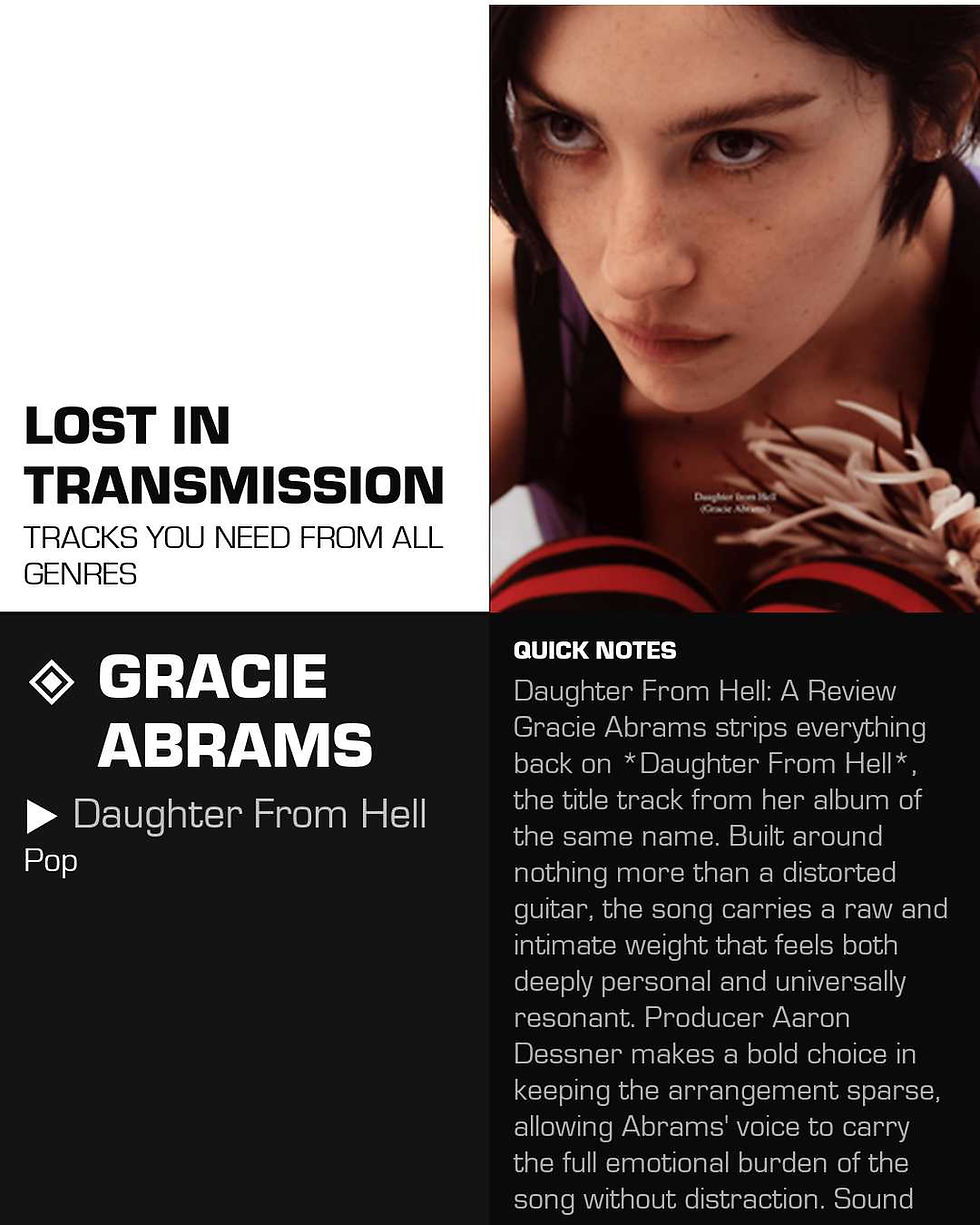
Daughter From Hell: A Review
Gracie Abrams strips everything back on Daughter From Hell, the title track from her album of the same name. Built around nothing more than a distorted guitar, the song carries a raw and intimate weight that feels both deeply personal and universally resonant. Producer Aaron Dessner makes a bold choice in keeping the arrangement sparse, allowing Abrams' voice to carry the full emotional burden of the song without distraction.
Sound and Production
The decision to anchor Daughter From Hell on distorted guitar alone is one of its most striking qualities. Where many artists might layer a song of this emotional magnitude with strings or atmospheric production, Dessner and Abrams resist that impulse entirely. The result is a soundscape that feels almost uncomfortably close, like overhearing a confession rather than listening to a polished record. The distortion adds a subtle edge that keeps Daughter From Hell from feeling overly soft, giving the song a tension that mirrors its emotional complexity.
Tone and Feeling
Daughter From Hell sits somewhere between a love song and an apology, and that duality gives it a tone that is tender but never saccharine. There is a quiet vulnerability to Abrams' delivery that makes the song feel lived-in and earned. The mood is reflective rather than dramatic, which suits the subject matter well. Abrams does not reach for grand gestures; instead, Daughter From Hell unfolds with a gentle honesty that makes its emotional impact all the more lasting.
A Turning Point
Written as one of the last songs for the album, Daughter From Hell carries the weight of a conclusion as much as a confession. Abrams has spoken about how the song immediately gave the album its title, and that sense of arrival comes through in the music itself. Daughter From Hell feels like a moment of clarity after a long period of searching, a song that knows exactly what it wants to say and trusts the simplest possible arrangement to say it.
Final Thoughts
Daughter From Hell is a quietly powerful piece of songwriting that benefits enormously from its restraint. Abrams and Dessner trust the song to speak for itself, and it does. As both a standalone track and the emotional centerpiece of the album, Daughter From Hell marks a meaningful transition in Abrams' artistry, one that moves with confidence from adolescence into something more open and more whole.
Listen To Gracie Abrams Daughter From Hell
Gracie Abrams Daughter From Hell Lyrics Meaning Explained
The meaning of Daughter From Hell by Gracie Abrams is a deeply personal reckoning with gratitude, guilt, and the slow process of understanding a parent's love one that arrives only after years of taking it for granted.
The Opening Metaphor
The song begins with one of its most striking images: "I was a pill, you swallowed me down." Abrams reaches into the familiar idiom of something being "a hard pill to swallow" and rebuilds it from the inside out. Rather than describing a situation that is difficult to accept, she makes herself the pill the unpleasant thing that must be endured. This immediately establishes the song's emotional posture: the speaker is not a victim recounting hardship, but someone looking back with clear eyes at the difficulty they caused. The lines that follow, "Daughter from hell, hungry and loud / You made me a plate / You lent me your life somehow," extend this into something almost paradoxical. Despite being described as a burden, the child was still fed, still cared for, still given a life. The word "lent" is particularly loaded, carrying a financial undertone that quietly introduces the theme of debt that runs throughout the entire song.
Imagery of Strength and Sacrifice
The second verse shifts into imagery that is richer and more elemental. "The mantle of stones / Your rosemary cloud / You talk to the trees out loud" paints the mother as someone who carries enormous invisible weight while remaining deeply connected to something spiritual or natural. The "mantle of stones" suggests burden and responsibility worn like a garment, while the rosemary and the trees suggest a quiet, almost meditative inner life. Then comes the song's most structurally important line: "With both of your hands / You held up our house." This is not merely a depiction of domestic labor. It frames the mother as the foundational force that kept the entire household from collapsing, doing so in the presence of a self-described "daughter from hell." The physical image of two hands holding something up communicates effort, strain, and an unwillingness to let go.
The Chorus as a Catalogue of Inheritance
The chorus functions differently across its three appearances, and this is where much of the song's emotional development lives. In the first chorus, the speaker wants "patience," "grace," and "sugar" qualities that read as the mother's defining traits, things the child received freely and perhaps never acknowledged. By the second chorus, the language shifts to "medal," "goodness," and "current," which suggests something more earned and active. A medal implies achievement; a current implies energy and motion. The speaker is no longer just grateful for what she was given in childhood but is beginning to recognize the moral and emotional magnitude of who her mother is. The final chorus reaches its most intimate point: "I want your color / I want you to know it / I want your mirror." To want someone's color is to want the essence of who they are. To want their mirror is to want to see yourself reflected in them, or to become a reflection of them entirely.
The Shoulder as Symbol
Recurring throughout each chorus is the line "I've loved your shoulder," which draws quietly on the idea of a shoulder to cry on. Rather than spelling this out, Abrams keeps it understated, which actually makes it more affecting. The shoulder is not presented as something dramatic or transformative it is simply loved. It has always been there. The repetition of this line across every chorus gives it the quality of something the speaker returns to again and again, the way one returns to a memory that keeps reasserting its importance.
The Outro and Its Resolution
The song closes with its most significant turn: "Daughter from hell, but I came around / I'll try to become you now." The title phrase reappears here not as self-condemnation but as something the speaker can now say with a kind of wry acceptance before immediately moving past it. The "but" is doing enormous work in that line it acknowledges the past without being imprisoned by it. The final declaration, to try to become the mother, completes a full arc. What began as a portrait of a difficult child receiving unconditional love ends as an act of aspiration. The speaker has moved from consuming her mother's qualities without awareness, to recognizing them, to actively wanting to embody them. It is a song about growing up, but more specifically about the precise moment when a person stops seeing a parent as a resource and starts seeing them as someone to admire.
Gracie Abrams Daughter From Hell Lyrics
Verse 1
I was a pill, you swallowed me down
They say that I got your mouth
Daughter from hell, hungry and loud
You made me a plate
You lent me your life somehow
Chorus
And I want your patience
I want your grace
I want your sugar
And I wanna say
How much I owe ya
I've loved your shoulder
Verse 2
The mantle of stones
Your rosemary cloud
You talk to the trees out loud
With both of your hands
You held up our house
And down to my bones
I hope that I make you proud
Chorus
And now I want your medal
I want your goodness
I want your current
And I wanna say
How much I owe ya
I've loved your shoulder
Instrumental Bridge
Chorus
(Ah-ah-ah)
I want your color (Ah-ah)
I want you to know it (Ah-ah)
I want your mirror (Ah-ah)
And I wanna say (Ah-ah)
How much I owe ya (Ah-ah)
I've loved your shoulder (Ah-ah)
(Ah-ah-ah)
I want your patience
I want your grace (Ah-ah)
I want your sugar (Ah-ah)
And I wanna say (Ah-ah)
How much I owe ya (Ah-ah)
I've loved your shoulder
Outro
Daughter from hell, but I came around
I'll try to become you now


Comments