
Noah Kahan Haircut Meaning and Review
A Quiet Arrival on The Great Divide
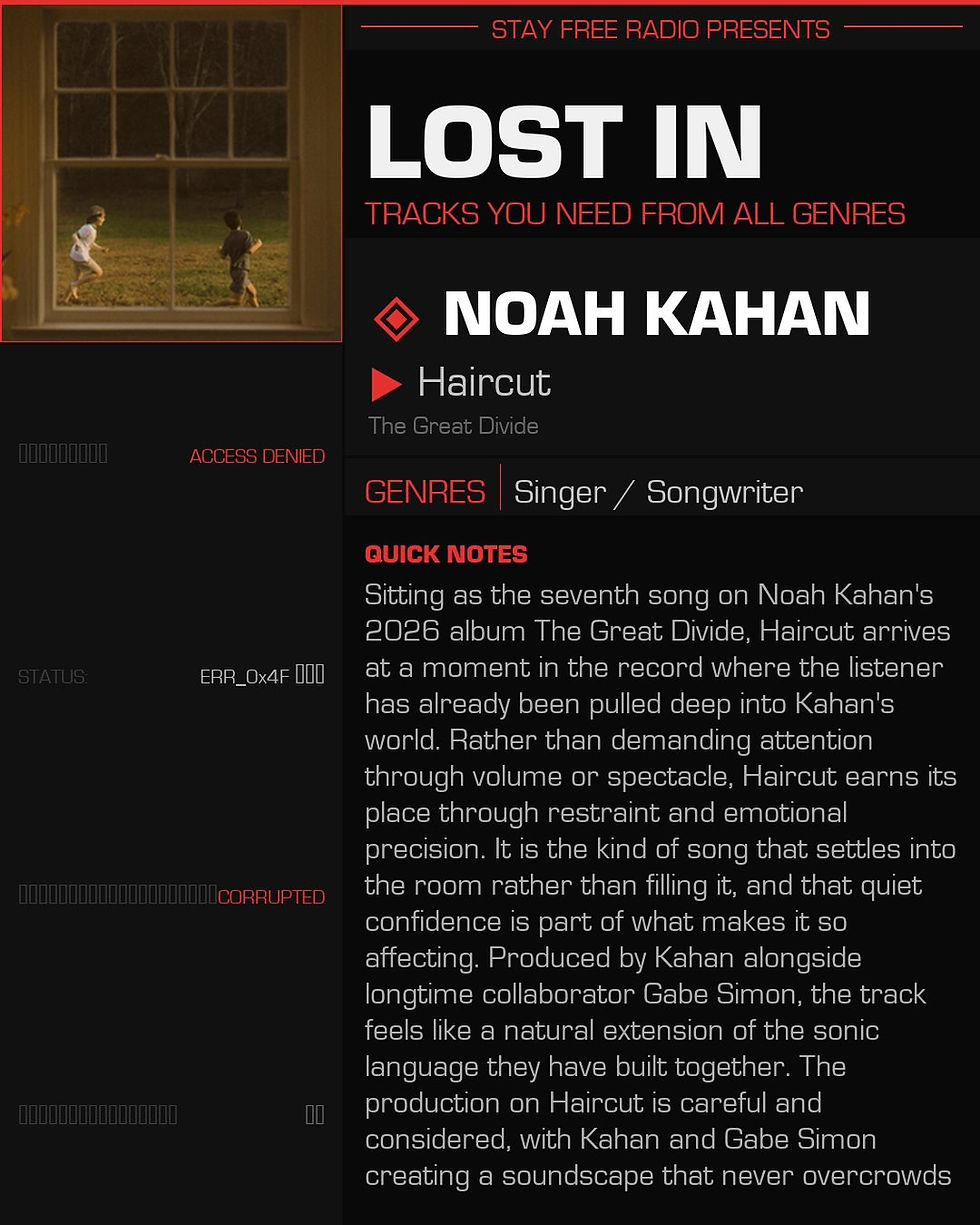
Sitting as the seventh song on Noah Kahan's 2026 album The Great Divide, Haircut arrives at a moment in the record where the listener has already been pulled deep into Kahan's world. Rather than demanding attention through volume or spectacle, Haircut earns its place through restraint and emotional precision. It is the kind of song that settles into the room rather than filling it, and that quiet confidence is part of what makes it so affecting. Produced by Kahan alongside longtime collaborator Gabe Simon, the track feels like a natural extension of the sonic language they have built together.
Production and Sonic Texture
The production on Haircut is careful and considered, with Kahan and Gabe Simon creating a soundscape that never overcrowds the emotional core of the song. There is a warmth to the arrangement that feels deliberate, with space left in the mix that allows each element to breathe. Simon and Kahan have a clear shared instinct for when to add and when to hold back, and Haircut benefits enormously from that discipline. The result is something that feels intimate without feeling sparse, lived in without feeling worn out.
Kahan's Vocal Performance
Noah Kahan's voice in Haircut carries the kind of weight that comes from genuine feeling rather than performance. He navigates the song with a tonal softness that occasionally tightens with tension, giving the listening experience a push and pull quality that keeps the ear engaged. There is no moment in Haircut where his delivery feels forced or overly produced. His voice sits naturally within the mix, treated with enough care in production to feel present and close without losing the rawness that defines his best work.
Tone and Emotional Atmosphere
The overall atmosphere of Haircut leans into a melancholy that is familiar territory for Kahan but executed here with particular grace. There is something deeply human about the mood the song creates, a kind of reflective sadness that does not tip into despair. The tone is bittersweet and unhurried, and Kahan and Simon seem to understand that the emotional power of Haircut lies in its patience. The song does not rush toward resolution. It sits with its feelings in a way that invites the listener to do the same.
Where Haircut Stands on The Great Divide
As the seventh song on The Great Divide, Haircut occupies an important position in the arc of the album. It functions as a moment of stillness within what is presumably a larger emotional journey across the record. Kahan and Simon have crafted something here that rewards repeated listening, a song that may not announce itself loudly on first encounter but grows more resonant with each return. Haircut is a testament to the kind of songwriting and production partnership that trusts the material enough to let it simply exist.
Listen To Noah Kahan Haircut
Noah Kahan Haircut Lyrics Meaning Explained
The meaning of Haircut by Noah Kahan is a reckoning with false intimacy, performed redemption, and the quiet dignity of being left behind. It is a song about someone who returned, claimed growth, and still managed to take more than they gave. Kahan holds them accountable not with rage but with something more withering: clarity.
Fame, Identity, and the Performance of Caring
From the opening verse, Kahan situates the song in a moment of crisis where someone is struggling and he moves to absorb the impact: "I stretched my arms real wide, tried to break your fall." But the admission that follows immediately undercuts the gesture. "I tried to heal your wounds just to say I helped, just to say that some small fame ain't made me someone else." This is a rare moment of self-implication. Kahan is not simply accusing the other person of being performative; he is catching himself in the same act. Helping has become a way of proving something, of maintaining a self-image that fame has quietly destabilized. The care on offer is real in form but compromised in motive, shaped more by ego than by genuine presence.
This self-interrogation complicates the song's moral landscape. He is not standing on clean ground while condemning someone else. He is standing on what the pre-chorus calls "uneven ground," acknowledging that neither of them is entirely innocent, but that the other person's performance is far more aggressive and far less honest about what it is.
Performed Redemption and the Jesus Complex
The second verse sharpens the accusation considerably. "You grew your hair out long, now you think you're Jesus Christ, there ain't nobody mistakin' your guilt for some great sacrifice." The image of long hair as a costume of martyrdom is pointed and a little savage. The other person has rebranded their past harm as a spiritual journey, aestheticizing their guilt rather than actually sitting with it. Kahan refuses the reframe. Growing your hair out and calling it transformation is not the same as transformation.
This connects directly to the pre-chorus accusation: "You ain't a goddamn hero now 'cause you cry on live TV." Public emotional display has replaced private accountability. The person has learned that vulnerability, performed in the right arena, generates sympathy and narrative control. Kahan strips that strategy bare. Crying on television is not evidence of a soul. It is evidence of an audience.
Roots, Community, and the Copper Mines
The line "for two hundred years, we laid bricks in the dirt, it's all there in the copper mines" grounds the song in something larger than a single relationship. This is not just a personal falling out; it is a departure from a shared history, a communal identity built through generations of labor. The copper mines are not decoration. They are proof. The "we" here carries real weight, invoking a collective that persisted long before this person arrived and will persist after they leave.
The second pre-chorus makes the betrayal explicit: "Got bored of the New Hampshire space, and left us for the New York Times." The move from place to platform, from community to coverage, is treated as a kind of abandonment. What was once lived and local has been traded for visibility. And now, having left, the person returns as "a ghost, tellin' people how you died," narrating their own departure as though it were a death rather than a choice, mining the community they left for content and credibility.
The Haircut as Symbol
The chorus is where the song's title earns its irony. "I'm happy for your haircut, I'm glad you got your act clean." On its face, this could be read as genuine well-wishing. In context, it is devastating. The haircut is a synecdoche for the whole project of the other person's reinvention: surface-level, cosmetic, designed to signal change without requiring it. Kahan offers congratulations that are technically polite and emotionally hollow, which is precisely the point. He is giving back the same quality of care he received.
The juxtaposition in the chorus is also worth sitting with. "Even if I'm eatin' fast food, sleepin' at my dad's place" is an image of someone who has not dressed up their circumstances or curated their struggle. He is in a bad place and he says so plainly. Against the other person's polished public narrative, Kahan's unglamorous honesty reads as a form of integrity. He has his soul still. They have a haircut.
Help Me If It Helps You
The post-chorus builds into one of the song's most quietly furious moments: "Help me if it helps you sleep, help me if it helps you write, help me if it helps you leave, help me if it helps you lie." The repetition of "help me if it helps you" redefines the entire dynamic. Every act of help or support in this relationship was ultimately in service of the other person's needs, their peace of mind, their creative material, their exits, their self-deception. The offer of help was never really about Kahan at all. By listing these four functions, the song exposes a pattern of instrumentalization dressed up as intimacy.
The Bridge and the Final Letting Go
The bridge delivers the song's most pointed image: "You walked into a haunted house and got angry at the ghosts." Coming back to a place you left and being disturbed by what remains is not the ghosts' failing. The haunted house did not invite the intrusion. The ghosts were there first. The anger belongs entirely to the person who returned expecting a clean room and found instead the residue of what they left behind.
"Spare us all the pity, love, save it for the microphone" brings the public performance theme full circle. The pity being offered is not for Kahan or the community; it is for the performer themselves. It belongs on a stage, not in a kitchen or a conversation. The community does not need it and will not receive it as the generous gesture it is being styled as.
The outro settles everything with five words: "We were fine without you, baby." This is not a wound, not a plea, not even an accusation. It is a statement of fact delivered with the steadiness of someone who has already moved through the hardest part. The final stage is not anger or grief. It is the quiet, unarguable truth that life continued, the ground held, and the absence was survived. The person who left for the New York Times and came back performing sorrow is simply no longer necessary to the story.
Noah Kahan Haircut Lyrics
Verse 1
Storm took the phone lines down and now your ride can't call
And you're bouncing off the walls, I stretched my arms real wide
Tried to break your fall but you got up, mad as hell and told me that I had it all
I tried to heal your wounds just to say I helped
Just to say that some small fame ain't made me someone else
Pre-Chorus
It ain't a high road now, it's just uneven ground
And I ain't even around to slow your speedin’ down
You told me, "If a lie turned true, a lie it would still be
You ain't a goddamn hero now 'cause you cry on live TV"
Chorus
But at least I got a soul still, even if I'm in a bad place
Even if I'm eatin' fast food, sleepin' at my dad's place
I'm happy for your haircut, I'm glad you got your act clean
You're showin' up like bad news and leavin' like a bad dream
Post-Chorus
Help me if it helps you sleep
Verse 2
I don't need your cosign now, oh, we get along just fine
For two hundred years, we laid bricks in the dirt, it's all there in the copper mines
You grew your hair out long, now you think you're Jesus Christ
There ain't nobody mistakin' your guilt for some great sacrifice
Pre-Chorus
Got bored of the New Hampshire' space, and left us for the New York Times
And now you stumble around like a ghost, tellin' people how you died
You told me, "If a lie turned true, a lie it would still be
You ain't a goddamn hero now 'cause you cry on live TV"
Chorus
But at least I got a soul still, even if I'm in a bad place
Even if I'm eatin' fast food, sleepin' at my dad's place
I'm happy for your haircut, I'm glad you got your act clean
You're showin' up like bad news and leavin' like a bad dream
Post-Chorus
Help me if it helps you sleep
Help me if it helps you write
Help me if it helps you leave
Help me if it helps you lie
Bridge
Crying in the bathroom, baby, drove your ass home
You walked into a haunted house and got angry at the ghosts
We were fine without you, baby, long after you're gone
Spare us all the pity, love, save it for the microphone
Oh
Chorus
But at least I got a soul still, even if I'm in a bad place
Even if I'm eatin' fast food, sleepin' at my dad’s place
I'm so happy for your haircut, I'm glad you got your act clean
You're showin' up like bad news and leavin' like a bad dream
Post-Chorus
Help me if it helps you sleep
Help me if it helps you write
Help me if it helps you leave
Help me if it helps you lie
Outro
We were fine without you, baby


Comments